
Advantages of gabion mesh in emergency situations
2025-11-26
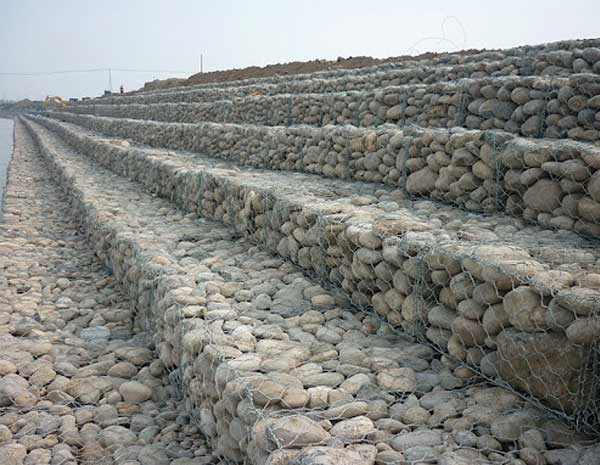
Gabion mesh is quick to install, easy to use, and requires no technical skills, making it particularly suitable for emergency situations. Water conservancy departments maintain annual reserves of gabion mesh.
For example: Collapse emergency response. When a reservoir dam collapses, throw boulders, sandbags, or gabions (made of wire or bamboo) along the collapsed section, starting with the most severely collapsed area at the top and proceeding sequentially until a stable slope is achieved.
Leakage emergency response. When seepage holes appear on the back slope or near the toe of the dam, traversing the dam body or foundation, locate the leak inlet. If the opening is small, quickly fill it with cotton wool, straw bags, or woven bags, or use straw bundles to form soft wedges for sealing. If the opening is large or there are many holes, place a large iron pot upside down or right-side up over the opening to cut off the water flow. Cover with tarpaulin or netting, then cover with sandbags and fill with clay to seal tightly.
Leakage emergency response. When dam seepage occurs, the method of "intercepting seepage on the water-facing slope and guiding seepage on the back slope" is adopted. On the water-facing slope, a front slope is constructed using low-permeability cohesive soil, or tarpaulins or geomembranes can be used for seepage control to reduce water infiltration. On the back slope, a filter is applied using more permeable sand, gravel, geotextiles, or straw to prevent soil loss, thereby lowering the phreatic line and maintaining dam stability. It is crucial to avoid using clay to suppress seepage on the back slope, as this will raise the phreatic line, leading to an expansion of the seepage area and exacerbating the potential danger.
For example: Collapse emergency response. When a reservoir dam collapses, throw boulders, sandbags, or gabions (made of wire or bamboo) along the collapsed section, starting with the most severely collapsed area at the top and proceeding sequentially until a stable slope is achieved.
Leakage emergency response. When seepage holes appear on the back slope or near the toe of the dam, traversing the dam body or foundation, locate the leak inlet. If the opening is small, quickly fill it with cotton wool, straw bags, or woven bags, or use straw bundles to form soft wedges for sealing. If the opening is large or there are many holes, place a large iron pot upside down or right-side up over the opening to cut off the water flow. Cover with tarpaulin or netting, then cover with sandbags and fill with clay to seal tightly.
Leakage emergency response. When dam seepage occurs, the method of "intercepting seepage on the water-facing slope and guiding seepage on the back slope" is adopted. On the water-facing slope, a front slope is constructed using low-permeability cohesive soil, or tarpaulins or geomembranes can be used for seepage control to reduce water infiltration. On the back slope, a filter is applied using more permeable sand, gravel, geotextiles, or straw to prevent soil loss, thereby lowering the phreatic line and maintaining dam stability. It is crucial to avoid using clay to suppress seepage on the back slope, as this will raise the phreatic line, leading to an expansion of the seepage area and exacerbating the potential danger.
 If the wire diameter of a stainless steel rope mesh is reduced, by how much will its impact resistance and load-bearing capacity decrease?
  Advantages and Application Scenarios of Expanded Metal Mesh
  Why Stainless Steel Mining Screens Rust and How to Treat Them After Rusting
  Gabion protection technology
  What factors should be considered when selecting zinc-steel fencing?
  What are the anti-corrosion processes for framed wire mesh fencing?
  Why are bent-profile guardrails the preferred choice for municipal and industrial park perimeter protection?
  Detailed Procedure for Installing External Wall Insulation Mesh
  What role does hot-dip galvanizing technology play in guardrail products?
  When it comes to balcony safety, it is worth learning more about stainless steel cable mesh fall-prevention netting.
  Understanding the Multifaceted Engineering Value of Stainless Steel Rope Mesh
  How to determine whether manufactured welded wire mesh meets quality standards
  Why is mesh used for wall plastering?
  Four simple steps to teach you how to install wall corner protectors
  How to make the mesh fabric adhere more firmly during external wall insulation?
  4 Practical Tips for Buying Fiberglass Mesh
  How to Choose Chain-Link Mesh
  Five Key Reasons to Choose Stainless Steel Rope Mesh: Reliability and Cost-Effectiveness
  How can gabion mesh be applied in complex terrain?
  How much do you know about the tensile strength and elongation of Gabion mesh?