
Why does fiberglass mesh have such good alkali resistance?
2025-11-04
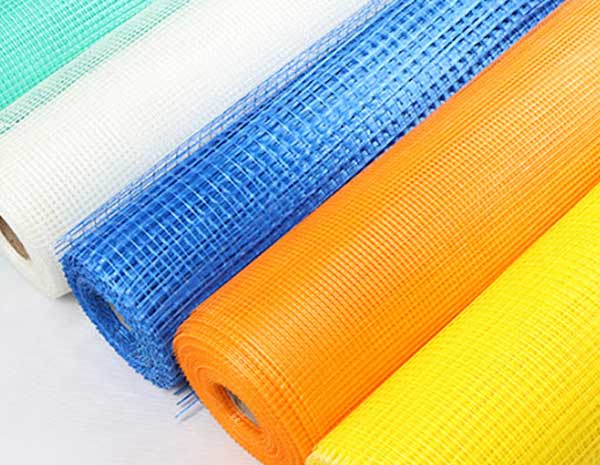
Fiberglass mesh exhibits excellent alkali resistance. Why? Because the mesh itself possesses this property. The surface of the mesh contains a mixed film of zirconium and titanium ions, effectively preventing corrosion from alkaline substances. Over time, the chemical state of zirconium gradually stabilizes. The alkali resistance retention rate of this alkali-resistant fiberglass mesh is greater than 85%, far exceeding that of other alkali-resistant coated fiberglass meshes; therefore, it can also be called a natural alkali-resistant fiberglass mesh.
14.5%~16.7% zirconium dioxide and 6% titanium dioxide are introduced into the glass composition. These are melted at 1600℃ and drawn into continuous filaments using a platinum funnel. These filaments are then spliced and twisted into woven fiberglass. During the drawing process, each filament is coated with a water-soluble epoxy resin and a coupling agent to ensure compatibility between the fiberglass mesh and the alkali-resistant polymer during subsequent processing.
To further improve the safe, stable, and durable performance of the alkali-resistant fiberglass mesh, after warp knitting into a leno form, it is coated again with styrene-butadiene rubber and pure acrylic emulsion. Constant temperature, constant speed, and constant tension control technology is used to ensure thorough adhesion. In the early stages, it effectively resists the erosion of fiberglass mesh by the Ca(OH)2 hydration period of polymer mortar. After coating, the anti-slip strength at the mesh joints is 3.5~4.5N.
Knowing the many performance characteristics of fiberglass mesh, such as alkali resistance, acid resistance, water resistance, cement erosion resistance, and good impact resistance, given these advantages, it also offers some protection against natural disasters and earthquakes.
Besides the product's advantages, the purchasing channel is also crucial. Therefore, it is essential to choose the correct mesh manufacturer and channel to avoid unnecessary losses.
The application of mesh in transformers is due to its seismic resistance. The principle is that mesh is used in transformers with filled concrete, with the reactor coil serving as a reinforcing material. Using this component can significantly reduce the weight of the integrally cast concrete floor, enhance prestressing, improve seismic resistance, and provide good sound insulation. Therefore, we can confirm that the application of mesh in external wall insulation systems has a certain role in earthquake resistance.
14.5%~16.7% zirconium dioxide and 6% titanium dioxide are introduced into the glass composition. These are melted at 1600℃ and drawn into continuous filaments using a platinum funnel. These filaments are then spliced and twisted into woven fiberglass. During the drawing process, each filament is coated with a water-soluble epoxy resin and a coupling agent to ensure compatibility between the fiberglass mesh and the alkali-resistant polymer during subsequent processing.
To further improve the safe, stable, and durable performance of the alkali-resistant fiberglass mesh, after warp knitting into a leno form, it is coated again with styrene-butadiene rubber and pure acrylic emulsion. Constant temperature, constant speed, and constant tension control technology is used to ensure thorough adhesion. In the early stages, it effectively resists the erosion of fiberglass mesh by the Ca(OH)2 hydration period of polymer mortar. After coating, the anti-slip strength at the mesh joints is 3.5~4.5N.
Knowing the many performance characteristics of fiberglass mesh, such as alkali resistance, acid resistance, water resistance, cement erosion resistance, and good impact resistance, given these advantages, it also offers some protection against natural disasters and earthquakes.
Besides the product's advantages, the purchasing channel is also crucial. Therefore, it is essential to choose the correct mesh manufacturer and channel to avoid unnecessary losses.
The application of mesh in transformers is due to its seismic resistance. The principle is that mesh is used in transformers with filled concrete, with the reactor coil serving as a reinforcing material. Using this component can significantly reduce the weight of the integrally cast concrete floor, enhance prestressing, improve seismic resistance, and provide good sound insulation. Therefore, we can confirm that the application of mesh in external wall insulation systems has a certain role in earthquake resistance.
 If the wire diameter of a stainless steel rope mesh is reduced, by how much will its impact resistance and load-bearing capacity decrease?
  Advantages and Application Scenarios of Expanded Metal Mesh
  Why Stainless Steel Mining Screens Rust and How to Treat Them After Rusting
  Gabion protection technology
  What factors should be considered when selecting zinc-steel fencing?
  What are the anti-corrosion processes for framed wire mesh fencing?
  Why are bent-profile guardrails the preferred choice for municipal and industrial park perimeter protection?
  Detailed Procedure for Installing External Wall Insulation Mesh
  What role does hot-dip galvanizing technology play in guardrail products?
  When it comes to balcony safety, it is worth learning more about stainless steel cable mesh fall-prevention netting.
  Understanding the Multifaceted Engineering Value of Stainless Steel Rope Mesh
  How to determine whether manufactured welded wire mesh meets quality standards
  Why is mesh used for wall plastering?
  Four simple steps to teach you how to install wall corner protectors
  How to make the mesh fabric adhere more firmly during external wall insulation?
  4 Practical Tips for Buying Fiberglass Mesh
  How to Choose Chain-Link Mesh
  Five Key Reasons to Choose Stainless Steel Rope Mesh: Reliability and Cost-Effectiveness
  How can gabion mesh be applied in complex terrain?
  How much do you know about the tensile strength and elongation of Gabion mesh?