
What are the different weaving methods for stainless steel wire mesh? Do these weaving methods affect its performance?
2026-03-17
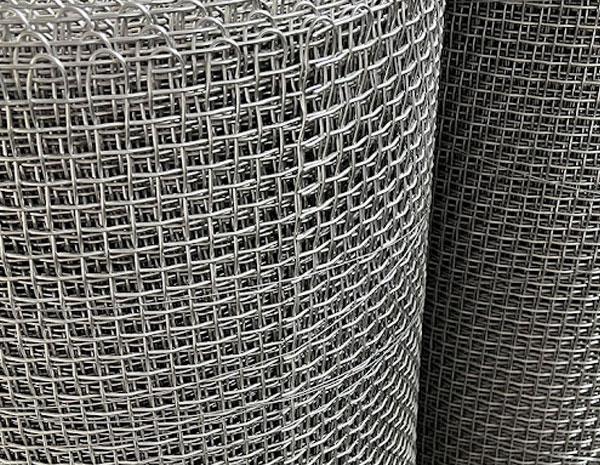
Stainless steel wire mesh can be woven in various ways, with plain weave and twill weave being the two most common. The following is a detailed introduction to these two weaving methods and their impact on the performance of stainless steel wire mesh:
I. Weaving Methods of Stainless Steel Wire Mesh
**Plain Weave (PW):** This is the most common weaving method.
**Plain Weave (PW):** This is the most common weaving method.
Each warp wire crosses over and under each weft wire. The warp and weft wires are of the same thickness, and the warp and weft threads form a 90-degree angle.
Both the horizontal and vertical stainless steel wires are straight, forming rectangular meshes.
**Twill Weave:** The warp and weft threads cross at an angle, causing the mesh to be slanted.
Each warp wire crosses over and under every two weft wires, and each weft wire crosses over and under every two warp wires.
Twill stainless steel wire mesh feels rough to the touch, and the twill weave is very dense.
Besides plain weave and twill weave, other weaving methods for stainless steel wire mesh include dense weave (mat weave), double-wire Dutch weave, and five-harness weave. These weaving methods each have their own characteristics, and can be selected according to specific application scenarios and needs.
II. The Impact of Weaving Method on the Performance of Stainless Steel Wire Mesh
* Strength and Stability: Twill-weave stainless steel wire mesh has a denser structure due to the oblique angle between the warp and weft wires, resulting in higher strength and better stability. In contrast, plain-weave stainless steel wire mesh may be slightly inferior in terms of strength and stability.
* Strength and Stability: Twill-weave stainless steel wire mesh has a denser structure due to the oblique angle between the warp and weft wires, resulting in higher strength and better stability. In contrast, plain-weave stainless steel wire mesh may be slightly inferior in terms of strength and stability.
Screening Accuracy and Filtration Effect: Twill-weave stainless steel wire mesh has a higher mesh density, resulting in higher screening accuracy and effectively filtering out fine particles or impurities. Plain-weave stainless steel wire mesh has relatively larger mesh openings, and its screening accuracy and filtration effect may not be as good as twill-weave.
Abrasion Resistance and Service Life: Due to its denser structure, twill-weave stainless steel wire mesh has better abrasion resistance, resulting in a longer service life. Plain-weave stainless steel wire mesh may be slightly inferior to twill-weave in terms of abrasion resistance, but the specific service life needs to be determined based on the actual application environment and conditions.
Application Scenarios and Requirements
Twill-weave stainless steel wire mesh, due to its high strength, high screening accuracy, and good wear resistance, is suitable for applications requiring high pressure, high-precision filtration, and long-term use. Plain-weave stainless steel wire mesh, on the other hand, is more suitable for applications where strength and screening accuracy requirements are not high.
Twill-weave stainless steel wire mesh, due to its high strength, high screening accuracy, and good wear resistance, is suitable for applications requiring high pressure, high-precision filtration, and long-term use. Plain-weave stainless steel wire mesh, on the other hand, is more suitable for applications where strength and screening accuracy requirements are not high.
In summary, the weaving method of stainless steel wire mesh has a significant impact on its performance. When selecting stainless steel wire mesh, the appropriate weaving method should be chosen based on the specific application scenario and requirements.
 If the wire diameter of a stainless steel rope mesh is reduced, by how much will its impact resistance and load-bearing capacity decrease?
  Advantages and Application Scenarios of Expanded Metal Mesh
  Why Stainless Steel Mining Screens Rust and How to Treat Them After Rusting
  Gabion protection technology
  What factors should be considered when selecting zinc-steel fencing?
  What are the anti-corrosion processes for framed wire mesh fencing?
  Why are bent-profile guardrails the preferred choice for municipal and industrial park perimeter protection?
  Detailed Procedure for Installing External Wall Insulation Mesh
  What role does hot-dip galvanizing technology play in guardrail products?
  When it comes to balcony safety, it is worth learning more about stainless steel cable mesh fall-prevention netting.
  Understanding the Multifaceted Engineering Value of Stainless Steel Rope Mesh
  How to determine whether manufactured welded wire mesh meets quality standards
  Why is mesh used for wall plastering?
  Four simple steps to teach you how to install wall corner protectors
  How to make the mesh fabric adhere more firmly during external wall insulation?
  4 Practical Tips for Buying Fiberglass Mesh
  How to Choose Chain-Link Mesh
  Five Key Reasons to Choose Stainless Steel Rope Mesh: Reliability and Cost-Effectiveness
  How can gabion mesh be applied in complex terrain?
  How much do you know about the tensile strength and elongation of Gabion mesh?