
The service life of 10% and 5% zinc-aluminum gabion mesh can be extended by 5-10 times.
2026-05-21
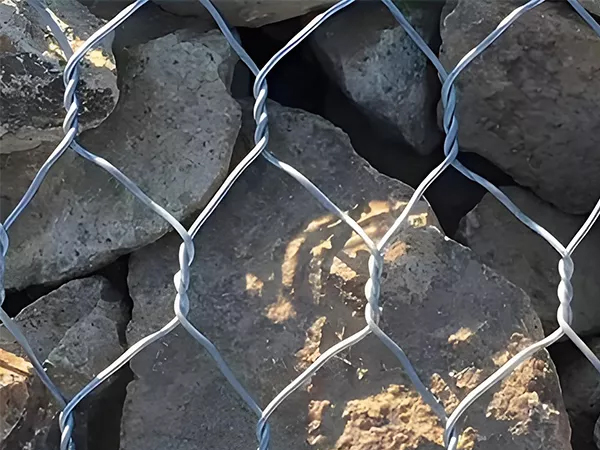
Experts favor gabions due to their strong corrosion resistance, signifying a more robust and stable corrosion control and protection. As a new type of hydraulic engineering product, gabions are becoming increasingly well-known and accepted.
10% and 5% zinc-aluminum gabion meshes are a type of enhanced dike protection mesh developed by our company based on ordinary galvanized gabion mesh. Compared to ordinary galvanized gabion mesh, its coating has stronger adhesion, better wear resistance and corrosion resistance, and superior construction performance.
The zinc-aluminum alloy coating possesses the same stability as aluminum-sprayed coatings and the same electrochemical protection as zinc-sprayed coatings, making it an ideal protective layer against seawater corrosion.
Zinc-aluminum alloy wire is used in weaving the mesh, extending its service life by 5-10 times.
Hot-dip 10% zinc-aluminum gabion mesh and hot-dip 5% zinc-aluminum gabion mesh (also known as zinc 10% aluminum gabion mesh, gabion baskets, or approximately zinc 5% aluminum gabion mesh) are woven from various specifications of 10% (or 5%) aluminum-zinc alloy low-carbon steel wire.
At the construction site, stones are added and dismantled to form a flexible, permeable, and integrated retaining structure for ecological protection projects.
The gabion wire is constructed using high-galvanized steel wire, approximately 10% zinc-aluminum alloy steel wire or 5% aluminum-zinc alloy low-carbon steel wire. If environmental conditions are harsh and pollution is severe, PVC coating can be applied to the surface of the wire to enhance its corrosion resistance. The use of gabions for protection in my country is a relatively recent development, while overseas research on gabions has been conducted for some time, finding that the service life of gabions largely depends on the lifespan of the steel wire.
Domestically, high-galvanized steel wire or aluminum-zinc alloy steel wire is most commonly used.
10% and 5% zinc-aluminum gabion meshes are a type of enhanced dike protection mesh developed by our company based on ordinary galvanized gabion mesh. Compared to ordinary galvanized gabion mesh, its coating has stronger adhesion, better wear resistance and corrosion resistance, and superior construction performance.
The zinc-aluminum alloy coating possesses the same stability as aluminum-sprayed coatings and the same electrochemical protection as zinc-sprayed coatings, making it an ideal protective layer against seawater corrosion.
Zinc-aluminum alloy wire is used in weaving the mesh, extending its service life by 5-10 times.
Hot-dip 10% zinc-aluminum gabion mesh and hot-dip 5% zinc-aluminum gabion mesh (also known as zinc 10% aluminum gabion mesh, gabion baskets, or approximately zinc 5% aluminum gabion mesh) are woven from various specifications of 10% (or 5%) aluminum-zinc alloy low-carbon steel wire.
At the construction site, stones are added and dismantled to form a flexible, permeable, and integrated retaining structure for ecological protection projects.
The gabion wire is constructed using high-galvanized steel wire, approximately 10% zinc-aluminum alloy steel wire or 5% aluminum-zinc alloy low-carbon steel wire. If environmental conditions are harsh and pollution is severe, PVC coating can be applied to the surface of the wire to enhance its corrosion resistance. The use of gabions for protection in my country is a relatively recent development, while overseas research on gabions has been conducted for some time, finding that the service life of gabions largely depends on the lifespan of the steel wire.
Domestically, high-galvanized steel wire or aluminum-zinc alloy steel wire is most commonly used.
 If the wire diameter of a stainless steel rope mesh is reduced, by how much will its impact resistance and load-bearing capacity decrease?
  Advantages and Application Scenarios of Expanded Metal Mesh
  Why Stainless Steel Mining Screens Rust and How to Treat Them After Rusting
  Gabion protection technology
  What factors should be considered when selecting zinc-steel fencing?
  What are the anti-corrosion processes for framed wire mesh fencing?
  Why are bent-profile guardrails the preferred choice for municipal and industrial park perimeter protection?
  Detailed Procedure for Installing External Wall Insulation Mesh
  What role does hot-dip galvanizing technology play in guardrail products?
  When it comes to balcony safety, it is worth learning more about stainless steel cable mesh fall-prevention netting.
  Understanding the Multifaceted Engineering Value of Stainless Steel Rope Mesh
  How to determine whether manufactured welded wire mesh meets quality standards
  Why is mesh used for wall plastering?
  Four simple steps to teach you how to install wall corner protectors
  How to make the mesh fabric adhere more firmly during external wall insulation?
  4 Practical Tips for Buying Fiberglass Mesh
  How to Choose Chain-Link Mesh
  Five Key Reasons to Choose Stainless Steel Rope Mesh: Reliability and Cost-Effectiveness
  How can gabion mesh be applied in complex terrain?
  How much do you know about the tensile strength and elongation of Gabion mesh?