
Let's talk about how to cleverly connect the chain link fence during installation.
2026-06-02
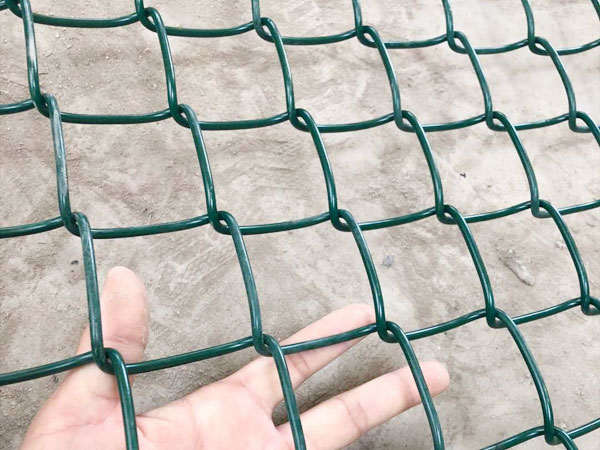
It is generally transported in lengths of several meters or tens of meters, and then cleverly connected to form a whole during installation. The specific method is as follows:
First, we install the posts according to the predetermined positions (generally at intervals of about 3 meters). There are two installation methods: flange and pre-embedded. Regardless of the method, it must be firmly fixed, because the posts will need to be pulled straight during the subsequent mesh installation, requiring them to withstand significant tensile force. To prevent the links from bending due to the flexible nature of the chain link fence, a long No. 8 iron wire is usually strung between the tops of the posts.
Next, lay the chain link fence flat on the ground. Thread the No. 8 wire through the sealed rough edge at the top of the chain link fence. Place the iron wire into the special hook at the top of the post and tighten it securely. The chain link fence should also be tightened. The method is to first fix one end to the post, then tighten the chain link fence and hang it to the other end, continuing in this manner until the end is reached.
Then, we come to the key point: connecting the ends. This requires ordering a section of untwisted chain link fence (which can be disassembled into individual wires) from the manufacturer when ordering. This is needed for the connection. Simply twist the disassembled individual wires and thread them between the two ends to connect them. After completion, there's no trace of the connection; it's quite amazing, isn't it?
Applications: Chain link fence, also known as chain link mesh fencing, combines rigidity and flexibility, and is especially able to withstand strong impacts. It is mainly used for stadium fencing, zoo fencing, pasture protection, and livestock fencing.
That's all for now regarding chain link fence. Want to know more? Then contact me!
First, we install the posts according to the predetermined positions (generally at intervals of about 3 meters). There are two installation methods: flange and pre-embedded. Regardless of the method, it must be firmly fixed, because the posts will need to be pulled straight during the subsequent mesh installation, requiring them to withstand significant tensile force. To prevent the links from bending due to the flexible nature of the chain link fence, a long No. 8 iron wire is usually strung between the tops of the posts.
Next, lay the chain link fence flat on the ground. Thread the No. 8 wire through the sealed rough edge at the top of the chain link fence. Place the iron wire into the special hook at the top of the post and tighten it securely. The chain link fence should also be tightened. The method is to first fix one end to the post, then tighten the chain link fence and hang it to the other end, continuing in this manner until the end is reached.
Then, we come to the key point: connecting the ends. This requires ordering a section of untwisted chain link fence (which can be disassembled into individual wires) from the manufacturer when ordering. This is needed for the connection. Simply twist the disassembled individual wires and thread them between the two ends to connect them. After completion, there's no trace of the connection; it's quite amazing, isn't it?
Applications: Chain link fence, also known as chain link mesh fencing, combines rigidity and flexibility, and is especially able to withstand strong impacts. It is mainly used for stadium fencing, zoo fencing, pasture protection, and livestock fencing.
That's all for now regarding chain link fence. Want to know more? Then contact me!
 If the wire diameter of a stainless steel rope mesh is reduced, by how much will its impact resistance and load-bearing capacity decrease?
  Advantages and Application Scenarios of Expanded Metal Mesh
  Why Stainless Steel Mining Screens Rust and How to Treat Them After Rusting
  Gabion protection technology
  What factors should be considered when selecting zinc-steel fencing?
  What are the anti-corrosion processes for framed wire mesh fencing?
  Why are bent-profile guardrails the preferred choice for municipal and industrial park perimeter protection?
  Detailed Procedure for Installing External Wall Insulation Mesh
  What role does hot-dip galvanizing technology play in guardrail products?
  When it comes to balcony safety, it is worth learning more about stainless steel cable mesh fall-prevention netting.
  Understanding the Multifaceted Engineering Value of Stainless Steel Rope Mesh
  How to determine whether manufactured welded wire mesh meets quality standards
  Why is mesh used for wall plastering?
  Four simple steps to teach you how to install wall corner protectors
  How to make the mesh fabric adhere more firmly during external wall insulation?
  4 Practical Tips for Buying Fiberglass Mesh
  How to Choose Chain-Link Mesh
  Five Key Reasons to Choose Stainless Steel Rope Mesh: Reliability and Cost-Effectiveness
  How can gabion mesh be applied in complex terrain?
  How much do you know about the tensile strength and elongation of Gabion mesh?