
How to express the density of stainless steel mesh
2025-03-19
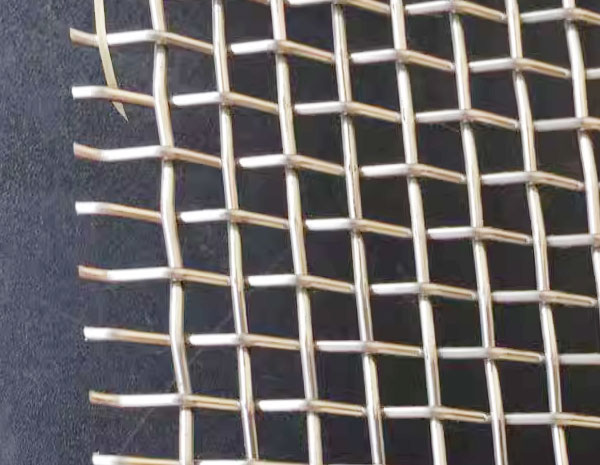
Density
Also known as screen density and fabric density. That is, the number of wires (threads) in the radial and weft length of the screen. The number of radial wires in the weft length is the radial wire density, and the number of weft wires in the radial unit length is the weft density. When the radial density of the screen is equal to the weft density, the screen density is equal to the mesh number stated in the screen specification;
Mesh number
Refers to the value of the woven mesh density, the number of mesh holes in the woven screen per inch. The mesh number can generally indicate the density between the wires of the screen. The higher the mesh number, the denser the screen and the smaller the mesh holes. On the contrary, the lower the mesh number, the sparser the screen and the larger the mesh holes.
For example, 6 mesh means there are 6 mesh holes in 1 inch. If the specification is 6 x 6 x 0.8mm, 6 refers to the mesh number.
Also known as screen density and fabric density. That is, the number of wires (threads) in the radial and weft length of the screen. The number of radial wires in the weft length is the radial wire density, and the number of weft wires in the radial unit length is the weft density. When the radial density of the screen is equal to the weft density, the screen density is equal to the mesh number stated in the screen specification;
Mesh number
Refers to the value of the woven mesh density, the number of mesh holes in the woven screen per inch. The mesh number can generally indicate the density between the wires of the screen. The higher the mesh number, the denser the screen and the smaller the mesh holes. On the contrary, the lower the mesh number, the sparser the screen and the larger the mesh holes.
For example, 6 mesh means there are 6 mesh holes in 1 inch. If the specification is 6 x 6 x 0.8mm, 6 refers to the mesh number.
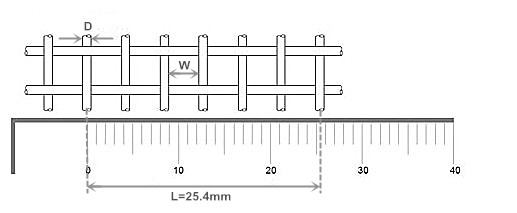
Wire diameter
Generally, the woven wire of the stainless steel mesh is round wire, and the wire diameter refers to the cross-sectional diameter of the round wire. The wire diameter is divided into weft wire and radial wire. The common units of stainless steel mesh wire diameter are millimeters (mm) and inches ("). The commonly used wire diameter gauges internationally are AWG (American), BWG (Birmingham), SWG (British), please refer to the corresponding wire number comparison table.
Aperture
The distance between two adjacent parallel wire diameters, excluding the size of the wire diameter.
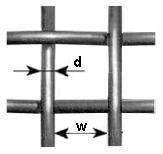
Conversion formula for wire diameter, aperture and mesh number
Conversion formula for stainless steel mesh specifications: 25.4/(wire diameter + aperture) = mesh number.
For example: The aperture of 6 mesh x 0.8mm wire diameter is 25.4/6-0.8=3.433mm.
Note: The wire diameter and mesh number of the warp and weft directions of the dense mesh stainless steel mesh are different, so they need to be calculated separately.
Calculation formula for the porosity of stainless steel mesh
The porosity of stainless steel mesh refers to the effective screening area of the stainless steel mesh, which is the percentage of the area of the hole to the area of the mesh surface.
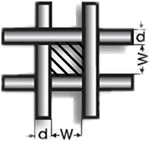
Under plain weave conditions, the porosity of stainless steel mesh = aperture x aperture/(aperture + wire diameter)2x 100%
For example: 6 mesh x 0.8mm, porosity = 3.433 x 3.433/(3.433 + 0.8)2 x 100%=65.77%.
Weight calculation formula
The weight calculation formula for stainless steel mesh plain weave/twill weave:
Wire diameter x wire diameter x mesh number x 0.5 = weight per square meter
For example: 6 mesh x 0.8mm wire diameter stainless steel mesh, weight per square meter = 0.8 x 0.8 x 6 x 0.5 = 1.92 kgs/sqm.
Because the wire diameter and mesh number of the warp and weft directions of the dense mesh stainless steel mesh are different, they need to be calculated separately and then added and divided by 2.
For example: 30x150 mesh, the wire diameter is 0.25mm x 0.18mm.
Weight per square meter = (0.25x0.25x30x0.5+0.18x0.18x150x0.5)x0.5=1.68375
 If the wire diameter of a stainless steel rope mesh is reduced, by how much will its impact resistance and load-bearing capacity decrease?
  Advantages and Application Scenarios of Expanded Metal Mesh
  Why Stainless Steel Mining Screens Rust and How to Treat Them After Rusting
  Gabion protection technology
  What factors should be considered when selecting zinc-steel fencing?
  What are the anti-corrosion processes for framed wire mesh fencing?
  Why are bent-profile guardrails the preferred choice for municipal and industrial park perimeter protection?
  Detailed Procedure for Installing External Wall Insulation Mesh
  What role does hot-dip galvanizing technology play in guardrail products?
  When it comes to balcony safety, it is worth learning more about stainless steel cable mesh fall-prevention netting.
  Understanding the Multifaceted Engineering Value of Stainless Steel Rope Mesh
  How to determine whether manufactured welded wire mesh meets quality standards
  Why is mesh used for wall plastering?
  Four simple steps to teach you how to install wall corner protectors
  How to make the mesh fabric adhere more firmly during external wall insulation?
  4 Practical Tips for Buying Fiberglass Mesh
  How to Choose Chain-Link Mesh
  Five Key Reasons to Choose Stainless Steel Rope Mesh: Reliability and Cost-Effectiveness
  How can gabion mesh be applied in complex terrain?
  How much do you know about the tensile strength and elongation of Gabion mesh?