
Stability of crimped wire mesh
2026-04-24
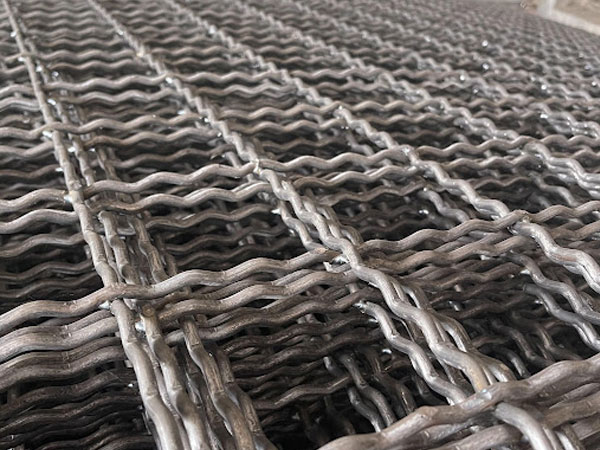
1. Structural Stability (Most Fundamental and Core): This refers to the ability of the crimped wire mesh to maintain its shape, wire diameter, and overall dimensions without deformation, loosening, or falling apart after weaving. It directly determines its core functions such as load-bearing and screening.
Key Performance Indicators: No tensile deformation of mesh openings (e.g., square holes turning into diamond shapes), no displacement of warp and weft wires, no loosening of edges, and no loosening of joints;
Core Influencing Factors:
Weaving Process Type:
* Plain Weave Crimped Mesh: Warp and weft wires are cross-woven, resulting in a compact structure but prone to deformation under lateral tension. Suitable for medium to low load applications.
* Twill Weave Crimped Mesh: More warp and weft wire interlacing points, resulting in higher structural strength than plain weave. It offers stronger tensile and impact resistance, making it suitable for mining screening and heavy-duty applications.
* Herringbone/Reverse Crimped Mesh: Special weaving angle (typically 30°-45°), resulting in uniform mesh tension and optimal deformation resistance. Used in high-frequency vibrating screening equipment.
* Plain Weave Crimped Mesh: Warp and weft wires are cross-woven, resulting in a compact structure but prone to deformation under lateral tension. Suitable for medium to low load applications.
* Twill Weave Crimped Mesh: More warp and weft wire interlacing points, resulting in higher structural strength than plain weave. It offers stronger tensile and impact resistance, making it suitable for mining screening and heavy-duty applications.
* Herringbone/Reverse Crimped Mesh: Special weaving angle (typically 30°-45°), resulting in uniform mesh tension and optimal deformation resistance. Used in high-frequency vibrating screening equipment.
Wire Diameter and Aperture Matching:
* Wire diameter too fine, aperture too large: Insufficient mesh support, easily deformed under load.
* Wire diameter too thick, aperture too small: Excessive rigidity but insufficient toughness, prone to breakage under low temperatures or impact.
* Wire diameter too fine, aperture too large: Insufficient mesh support, easily deformed under load.
* Wire diameter too thick, aperture too small: Excessive rigidity but insufficient toughness, prone to breakage under low temperatures or impact.
Industry Optimal Matching: Aperture/wire diameter ratio is typically controlled between 3-8 (adjusted according to material; steel mesh can be relaxed to...). 10. Plastic mesh needs to be reduced to 2-5 mm); Edge treatment and splicing process: Untreated edges: Warp and weft threads are prone to loosening, leading to overall structural instability; Common stabilization treatments: Folding, edge binding (stainless steel strip/flat steel), welding (spot welding/continuous welding), and snap fastening. Among these, welded edges offer the best structural stability (suitable for heavy-duty applications); Weaving tension control: Uneven warp and weft thread tension during production: Localized stress concentration on the mesh surface, easily leading to "localized bulging" or deformation after long-term use; Standard requirement: Tension error during weaving ≤ ±5%, ensuring uniform stress on the mesh surface.
2. Material stability (key to long-term use) Refers to the ability of raw materials to maintain stable physical properties (strength, toughness) and chemical properties (corrosion resistance, aging resistance) in the usage environment, determining the service life of the crimped wire mesh.
 If the wire diameter of a stainless steel rope mesh is reduced, by how much will its impact resistance and load-bearing capacity decrease?
  Advantages and Application Scenarios of Expanded Metal Mesh
  Why Stainless Steel Mining Screens Rust and How to Treat Them After Rusting
  Gabion protection technology
  What factors should be considered when selecting zinc-steel fencing?
  What are the anti-corrosion processes for framed wire mesh fencing?
  Why are bent-profile guardrails the preferred choice for municipal and industrial park perimeter protection?
  Detailed Procedure for Installing External Wall Insulation Mesh
  What role does hot-dip galvanizing technology play in guardrail products?
  When it comes to balcony safety, it is worth learning more about stainless steel cable mesh fall-prevention netting.
  Understanding the Multifaceted Engineering Value of Stainless Steel Rope Mesh
  How to determine whether manufactured welded wire mesh meets quality standards
  Why is mesh used for wall plastering?
  Four simple steps to teach you how to install wall corner protectors
  How to make the mesh fabric adhere more firmly during external wall insulation?
  4 Practical Tips for Buying Fiberglass Mesh
  How to Choose Chain-Link Mesh
  Five Key Reasons to Choose Stainless Steel Rope Mesh: Reliability and Cost-Effectiveness
  How can gabion mesh be applied in complex terrain?
  How much do you know about the tensile strength and elongation of Gabion mesh?